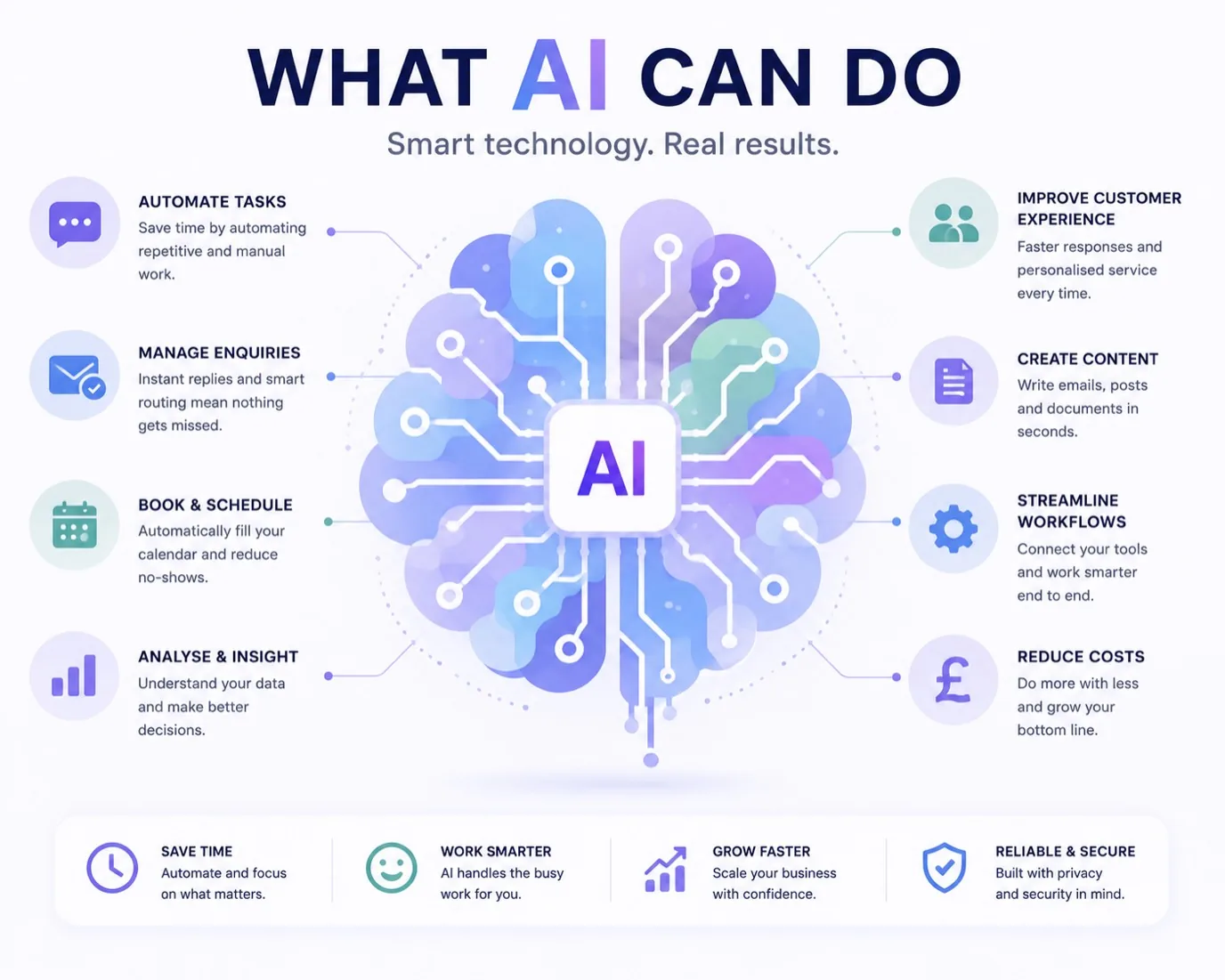
AI is everywhere in the news. You hear about it replacing jobs, generating art, writing code. But as a small business owner, the question you have is simpler: what can it actually do for me? Will it make my business better, faster or cheaper? Or is it just hype?
The honest answer: AI is genuinely useful for small businesses, but not in the dramatic ways headlines suggest. It won't revolutionise your industry or make you redundant. What it can do is take hours of routine work off your plate so you can focus on the decisions that actually matter.
What AI is Actually Good At
Artificial intelligence excels at finding patterns in large amounts of information and doing the same thing repeatedly without getting tired or making careless mistakes. That's useful for specific business tasks.
Automating repetitive processes. If you spend hours every week on tasks that follow a fixed process, AI can handle them. Writing customer responses to common questions, scheduling appointments, generating invoices, categorising emails, extracting data from documents. These are all pattern-based work that AI does reliably.
Extracting insights from data. Most small businesses sit on data they don't fully use. Your sales records, customer behaviour, traffic patterns, inventory levels. AI can scan through it and surface useful patterns you might have missed. Customers who are likely to churn. Products that consistently generate repeat orders. Times when demand peaks.
Improving how you find things. If you have extensive notes, documents, past conversations or project records, AI can search through them semantically. Not just "find the word invoice" but "find all conversations about late payments from commercial clients". That saves hours of digging.
Creating a first draft that you refine. For marketing copy, product descriptions, emails, meeting notes, outlines, AI can generate a decent first draft that you edit and improve. It's faster than starting from a blank page for someone who doesn't do that work regularly.
Personalising at scale. If you want to tailor emails, product recommendations or offers to individual customer segments, AI can help you generate variations quickly. You could send different messages to new customers versus loyal ones, or to customers in different parts of the UK, without spending all day writing variants.
What AI is Not Good At
It's just as important to understand the limits.
AI can't genuinely understand your business the way you do. It can't make judgment calls that require deep contextual knowledge. It can't innovate or develop new strategies. It struggles with work that needs genuine human empathy, or situations where the rules aren't clear and predefined.
It's also not a shortcut to strategy. You still need to decide what to optimise for, what matters to your customers, and how to compete. AI can help you execute faster, but it can't replace thinking about your business.
And it sometimes gets things wrong in subtle ways. It might generate copy that sounds plausible but contains inaccuracies. It might optimise for the wrong metric. It might make connections that aren't real. You have to treat AI as a tool that needs human oversight, not a replacement for it.
Real Use Cases for Small Businesses
Customer enquiry handling. Every enquiry usually involves answering similar questions: are you available, what does it cost roughly, can you do this specific thing. AI can handle initial responses, gather key details, and either book a call with you or send through to your calendar. The customer gets an immediate response instead of waiting until you're free. You only spend time on qualified leads.
Follow-up automation. Most small businesses don't follow up with past customers because it feels like pestering them. An AI system can send timely, relevant follow-ups without feeling pushy. A builder can remind customers about annual roof inspections. A hairdresser can let clients know about a new treatment. A plumber can highlight seasonal maintenance work. It works because it's personalised and genuinely useful to the customer.
Faster quoting. If you quote projects regularly, you spend time rehashing the same calculations. An AI system can capture your pricing logic, material costs and labour rates, then generate quotes in minutes instead of hours. More quotes sent faster means more jobs booked.
Categorising and tagging data. If you collect customer information but never really use it because it's not organised, AI can categorise it. It can tag emails by type, categorise customer enquiries, identify which invoices are overdue, flag high-value customers. Once it's organised, you can actually analyse it and act on it.
Drafting internal communications. If you write emails, meeting notes, reports or briefs, AI can generate a draft that you edit. For someone who spends an hour writing what should take ten minutes, this is genuinely time-saving.
Content and marketing support. If you write blog posts, email newsletters, social media posts or web copy, AI can help you brainstorm, generate drafts, or create variations for different audiences. You're still making the decisions and editing for accuracy, but you're not starting from a blank page.
How to Start Small and Scale
The mistake most small businesses make is overcomplicating it. You don't need to transform your entire operation overnight.
Pick one problem that costs you time or money. It should be something repetitive, follow a predictable pattern, and happen regularly enough that automating it actually matters. Then find or build a solution for that single problem.
Once it's working and saving you time, you'll see the opportunity to improve something else. Maybe it's scheduling. Maybe it's data organisation. Maybe it's customer follow-up. Build from there.
This approach keeps the scope manageable, lets you learn what works, and means you're not paying for complexity you don't need.
Why Work with a Professional
You can find general-purpose AI tools online. ChatGPT, Gemini, Claude. They're useful for brainstorming, drafting and thinking through problems.
But custom AI automation is different. You're building something that integrates with your business, handles sensitive customer data, and needs to work reliably 24/7. That requires someone who understands both the tool and your business. It's the difference between using a spreadsheet to manage your invoices and having proper bookkeeping software designed for your industry.
Explore what automation could do for your business or talk through your specific situation with us. We work with small business owners across the UK, and we focus on automations that actually save you time and money, not just the automations that are technically flashy.
Common Concerns (and Honest Answers)
Will it put my staff out of work? If anything, it's the opposite. It removes the tedious parts of their jobs so they can do higher-value work. A customer service person stops answering the same questions repeatedly and starts solving actual problems. A sales person stops manually entering data and starts having real conversations with leads.
What if it makes a mistake on a customer-facing thing? You control the guardrails. For anything important, you can require human approval before it reaches a customer. For lower-stakes things, mistakes are usually minor and fixable. And AI is often more reliable than humans for repetitive tasks, because it doesn't get tired or distracted.
Isn't it really expensive? It depends what you automate, but most small business automation is surprisingly affordable. You're not paying for artificial general intelligence. You're paying for tooling that does one specific job well. That can be modest.
What about privacy and data security? Those are legitimate concerns. If you're using external services, you need to understand where your data goes. If you're building custom automation, you control the data and who has access. We always encrypt sensitive information and we comply with data protection regulations.
How do I know it will work for my business? You don't until you try it. That's why we usually start with a small proof of concept. You see the impact, you understand how it works, and then you decide whether to expand it.