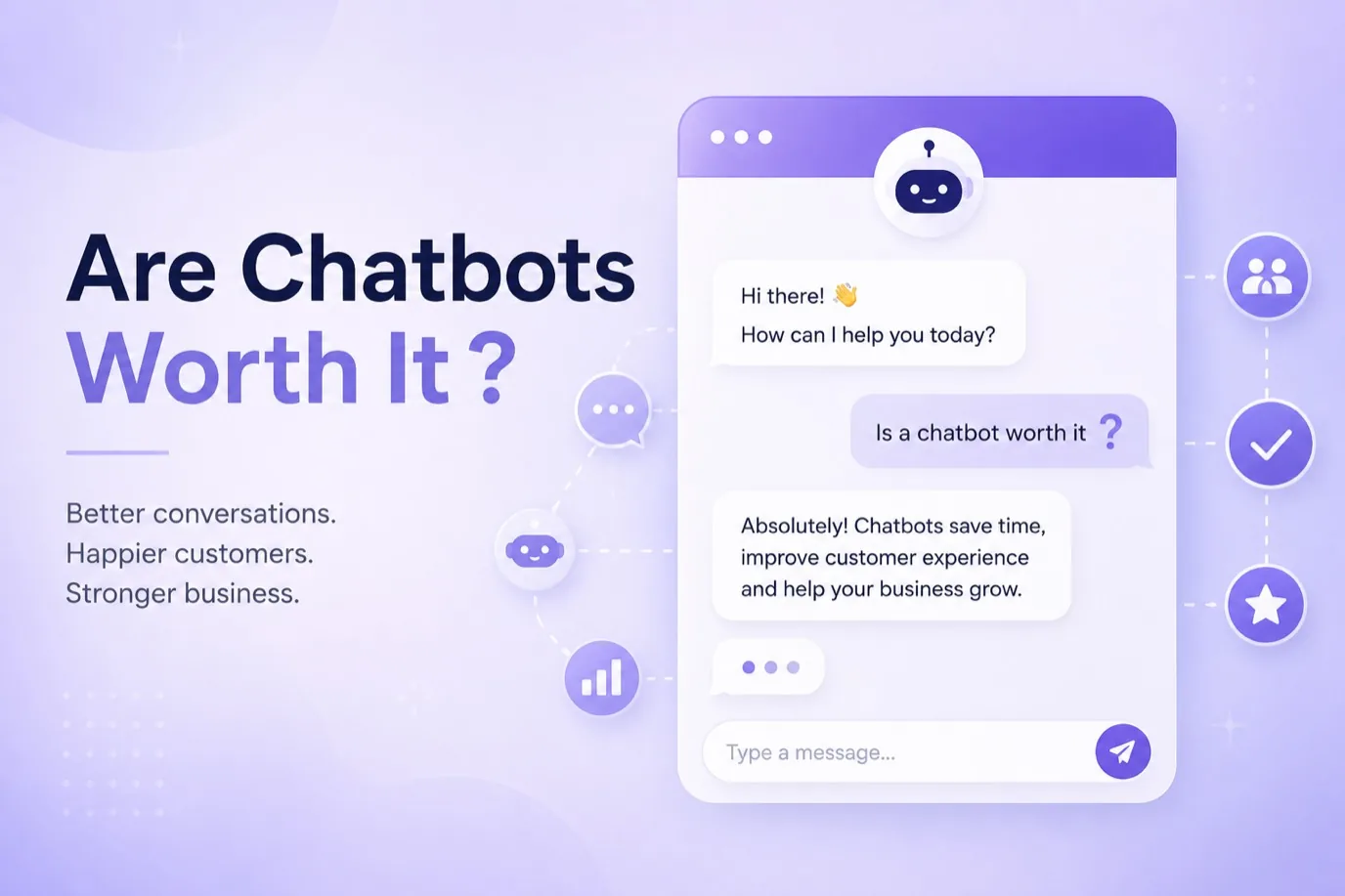
The question most small business owners ask about chatbots isn't whether they're impressive. It's whether they're worth the time and money. Will a chatbot on your website actually convert more customers, save your team time, or does it just look like a gimmick?
The honest answer is it depends. Done well, a chatbot can save you real time and recover lost leads. Done poorly, it's a frustrating experience that makes customers dislike your business. The difference is usually in how specific the chatbot is to what you actually do, and what you're trying to achieve.
What Chatbots Actually Do
A modern AI chatbot reads what a customer types and responds with relevant information or next steps. It's not a robot that speaks like a robot. It's a system that understands questions and answers them in a way that feels natural.
The best chatbots aren't trying to sound human or build a relationship. They're trying to answer common questions fast so your customer can move forward. What's your pricing? Do you work with businesses like mine? Can I book an appointment? Can I pay an invoice? These are things chatbots handle well because they're factual questions with consistent answers.
Where chatbots struggle is with nuance. Complex problems, emotional situations, or customer complaints need a human. A chatbot can acknowledge these and route them to a real person, but it shouldn't be the only tool handling difficult situations.
When Chatbots Save Time
Chatbots make sense when you spend several hours a week answering the same questions. A plumber in the Wirral might get asked "do you work Sundays" ten times a week. A salon answers "what's your cancellation policy" multiple times a day. A gym is asked "are you open on bank holidays" constantly.
Each of these questions takes two minutes to answer and type out. Over a year, that's dozens of hours. A chatbot answers those questions instantly and frees someone up to do something more valuable.
More importantly, chatbots let customers help themselves outside your business hours. Someone might fill out a booking form at 9pm on a Saturday knowing they'll get an answer immediately. Without a chatbot, they either get an automated "we'll be in touch on Monday" or they call a competitor instead.
When Chatbots Don't Make Sense
Chatbots don't help if your business has only a handful of questions or if every customer situation is unique. A consultant who works on custom projects doesn't need a chatbot answering questions because the answer to almost everything is "it depends on your situation." A skilled tradesperson might waste time because the chatbot can't assess the actual problem.
They also don't make sense if you're not ready to keep the information it refers to up to date. If your chatbot is telling customers "our team works 9-5 Monday to Friday" but you changed that three months ago and forgot to update the chatbot, you've damaged your reputation rather than helping it.
The Cost vs Benefit Calculation
A simple chatbot can cost almost nothing. Many website tools now include basic chatbots for free. They have limitations (they only know what you tell them), but for simple questions they work fine.
A more sophisticated chatbot that learns from your website, your previous conversations, and your business documents costs more, but it can handle more nuance and gives better answers.
The real cost isn't usually the software. It's your time setting it up correctly, writing the information it needs to refer to, and maintaining it over time. If you treat a chatbot as a "set it and forget it" tool, it'll eventually give wrong information and hurt you.
The benefit is usually measured in saved time. How many hours a week does your team spend on routine questions? A chatbot can probably eliminate a significant portion of those. That's the number you compare against the cost.
Common Mistakes
The biggest mistake is building a chatbot that sounds like a chatbot. Generic, formal responses that offer no personality or warmth. If you have a brand personality (friendly, professional, informal, expert), the chatbot should have it too.
Another mistake is making the chatbot do too much. It shouldn't try to sell, build relationships, or handle complex problems. It should answer questions and hand off to a human when needed.
The third mistake is not measuring whether it's working. Track how many conversations the chatbot handles, how many get handed off to a human, how many result in bookings or sales. If it's handling five percent of conversations and the rest are frustrating people, it's a waste.
Frequently Asked Questions
What's the difference between a simple chatbot and an AI chatbot?
A simple chatbot follows decision trees: "if they ask about pricing, show pricing." It only knows what you explicitly tell it. An AI chatbot (using large language models) understands the meaning of questions, finds relevant answers from your entire website or knowledge base, and can handle questions phrased in multiple ways. AI chatbots are more helpful but usually cost more.
Will a chatbot handle complaints or angry customers well?
No, not usually. A chatbot should recognise when someone is frustrated or complaining and hand them off to a human immediately. If a customer is upset, they need to talk to a real person, not a chatbot. That handoff should be smooth and fast.
How do I know what questions my chatbot should be able to answer?
Start by tracking actual customer questions. Read your email for the past three months. Which questions repeat? Which ones take the most time to answer? Build the chatbot around those first. You can expand it later based on what customers actually ask.
Can I use a chatbot on my phone app as well as my website?
Yes. Most chatbot platforms work across channels: website, mobile app, Facebook Messenger, WhatsApp. The same chatbot can serve customers wherever they reach out from.
What if a chatbot gets something wrong and makes a customer unhappy?
A well-designed chatbot includes a feedback mechanism so customers can tell you something was wrong. You fix the information or the response, and the chatbot learns. Most businesses include a button that says "this wasn't helpful, talk to a human" so customers can always escape to a person if they need to.
Is It Worth It?
For most small businesses, a simple, focused chatbot is worth the effort. Not the fancy generalist chatbots, but a straightforward tool that answers your most common questions, saves your team time, and keeps customers moving forward.
Get in touch to discuss whether a chatbot makes sense for your business. We can help you understand which questions are worth automating and how to set one up that actually improves your customer experience instead of damaging it.
The goal isn't to impress people with technology. It's to handle routine interactions so your team can focus on relationships and problems that actually need a human. If a chatbot does that, it pays for itself.