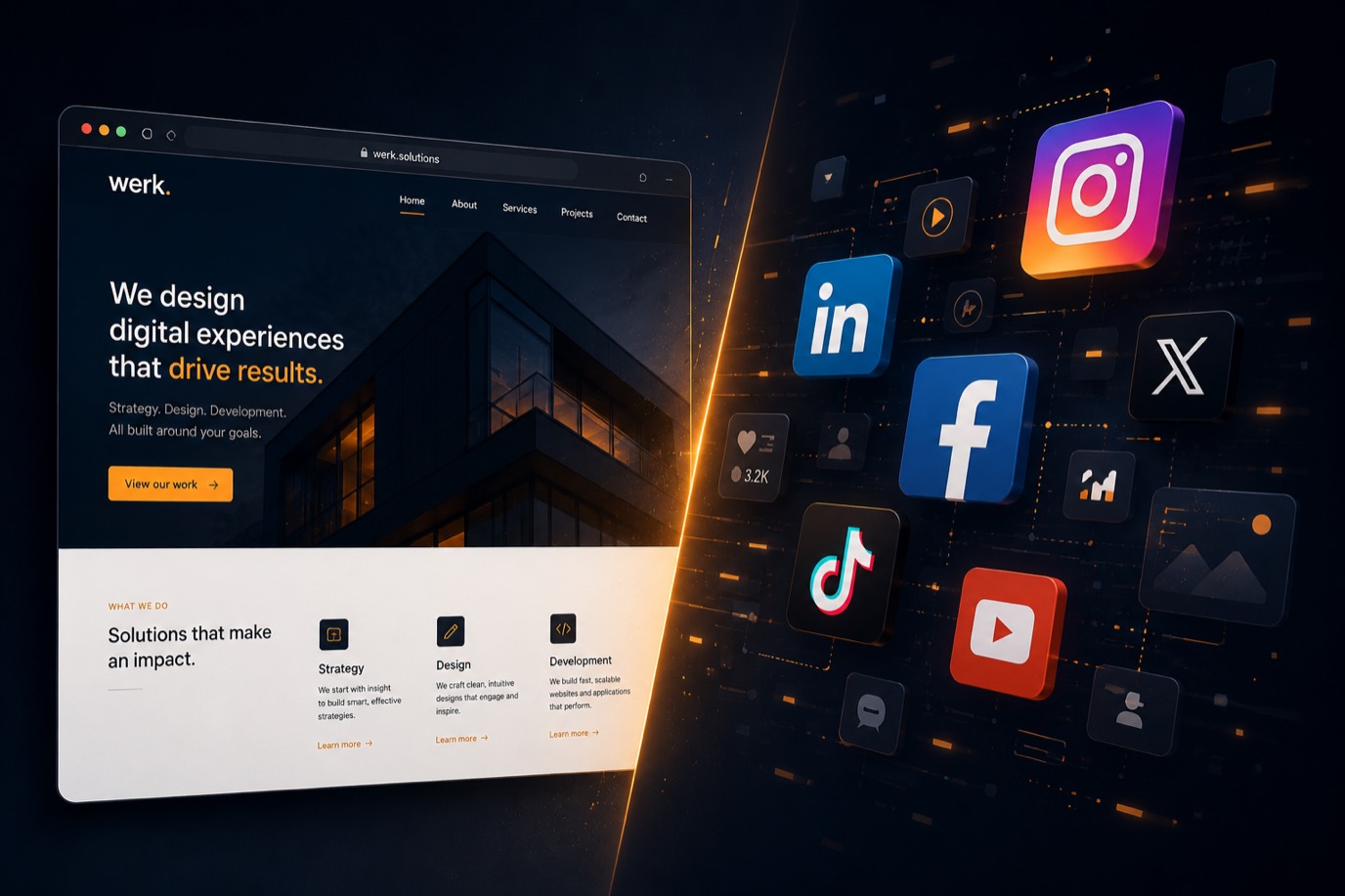
Many small business owners feel torn between investing in a website and focusing their time on social media. Social platforms are free, visible, and where your customers already spend time. A website costs money and feels like one more thing to manage. The answer isn't either or. Both serve different purposes, and for most businesses, you actually need both. This guide explains why and helps you decide where to invest first.
What a website does that social media doesn't
A website is your owned property. It sits on your domain, in your control. Social media platforms are rented spaces. Instagram, Facebook, and TikTok set the rules. They change their algorithms, limit your reach to drive ads, sometimes shut down accounts, and they could disappear tomorrow. Your website won't do any of those things.
A website also builds credibility in ways social doesn't. A customer who finds you on Google, lands on your professional website, and sees your portfolio or testimonials is more likely to trust you than someone who only knows you from a social media profile. Websites signal permanence and professionalism. They're where you control the entire customer experience without platform interference or distracting ads.
Websites also rank in Google. If a potential customer searches for what you do, they find your website in search results. Social media posts rarely appear in Google unless they're specifically looking for your business name. For local businesses on the Wirral or anywhere else, this matters enormously. A plumber in Liverpool who ranks for "emergency plumbing Liverpool" gets found. The same plumber with only a Facebook page might not.
Websites also handle things social can't. E-commerce, booking systems, contact forms that send leads to your email, detailed service pages with FAQs, customer testimonials, project portfolios. These features live on a website. Social can point to them, but you're limited in what you can do on a platform designed for scrolling and engagement, not transactions.
What social media does that a website doesn't
Social media is where visibility happens now. Algorithms push content to audiences. Hashtags and shares amplify reach. You can post something and reach thousands of relevant people within hours, often for free. A new website gets zero traffic until people know it exists.
Social is also where conversation happens. Customers comment, share, react. You build community and relationship in a way that's much harder on a website. Social is intimate and immediate. People use it every single day, sometimes dozens of times. Your customers are there.
Social is also faster to produce. You can write a post and hit publish in minutes. A website requires planning, design, copywriting, and development. Social is agile. You can test ideas quickly and see what resonates. You can respond to trends and current events in real time.
Social is also where permission-based marketing happens. People follow you, choose to see your content. They've already opted in. On a website, you're hoping people find you through search or referral. On social, you have an audience.
You actually need both
For almost every small business, the optimal strategy is both. A website gives you credibility, search engine visibility, and a platform to handle transactions and detailed information. Social media gives you daily visibility, community building, and direct access to your audience.
The question isn't whether to choose one. It's which to prioritize and how to connect them. If you're a freelancer or service provider just starting out, a simple website and an active social presence beats an expensive website and no social. The website can be modest at first. It just needs to exist, be professional, and help people understand what you do.
As you grow, both become stronger. Your website captures search traffic and converts visitors to customers. Your social media points to your website and drives direct visitors. They work together. Your website is your storefront. Social media is your loud speaker.
Start with a website if you can
If you have to choose one, choose a website. Here's why. You control it entirely. You own it. Customers can find you through Google. You build credibility. And if you do invest in social media later, your website becomes a destination. Links from social point there. Content on social drives traffic there.
A basic website doesn't have to be expensive or complicated. It just needs a few pages: who you are, what you do, who you help, how to contact you, maybe a portfolio or testimonials. It should work on mobile. It should load quickly. It should be secure. Beyond that, you can keep it simple.
Many successful small businesses on the Wirral and across the UK started with a modest website and added social media when they had capacity. They built website traffic first, then used social to amplify. It works in reverse too, but without a website, you're relying entirely on platforms you don't control.
Make social and website work together
Once you have both, connect them deliberately. Your website should link to your social profiles. Your social profiles should direct traffic to specific pages on your website, not just your homepage. A social post about a promotion should link to the relevant page on your website. Your email signature should include links to both.
This amplifies both. Social gives you daily visibility and engagement. Your website captures that traffic and converts it into leads, sales, or bookings. The website is where serious inquiry happens. Social is where discovery and conversation happen.
Don't make your social bio a question mark. Put your website URL there. Don't post stunning content to social and not link anywhere. Post it to social, then link people to your website where they can take action.
The exception: if you're a restaurant or venue
If you run a restaurant, bar, gym, or similar venue, social media becomes more important than usual. People look up your hours, photos, reviews, and vibe on social first. They might check Instagram before your website. Your physical location and immediate presence matter more.
Even then, a website still makes sense. It's a backup if social goes down. It ranks in Google. It lets you manage reservation or ticketing systems. It's where serious inquiry happens. But for venues and restaurants, social can be closer to equal priority.
Frequently Asked Questions
Can I skip the website and just do social media? You can, but you'd be limited. You're betting everything on platforms you don't control. You can't rank in Google. You can't capture serious inquiries. You can't run an e-commerce store. You'll spend more energy fighting algorithms and reaching people. A basic website doesn't cost much and returns a lot of value. It's worth doing.
How much time should I spend on social versus my website? Once your website exists, more time on social. A website is mostly passive once it's built. Social requires regular posting and engagement to work. But this assumes your website exists. If you don't have one yet, build it first, then invest in social.
Should I use social media tools or a page builder to replace a website? Some page builders live on social platforms. These are quick to set up, but they lock you into that platform. You don't build search engine visibility. You don't own the content. For anything beyond testing, a real website is worth the investment.
What if I already have social media and no website? Should I build the website now? Yes. Social media is good. A website is better. Having both is best. You're already doing the hard work on social. Adding a website multiplies that effort's value. Every post you make on social can drive traffic to your website.
Moving forward
Your best strategy is clear: build a solid website that handles what matters to your business. Then invest in social media to drive visibility and conversation. They serve different purposes. Together, they're much stronger than either alone. Learn how to approach a website project that actually serves your business.