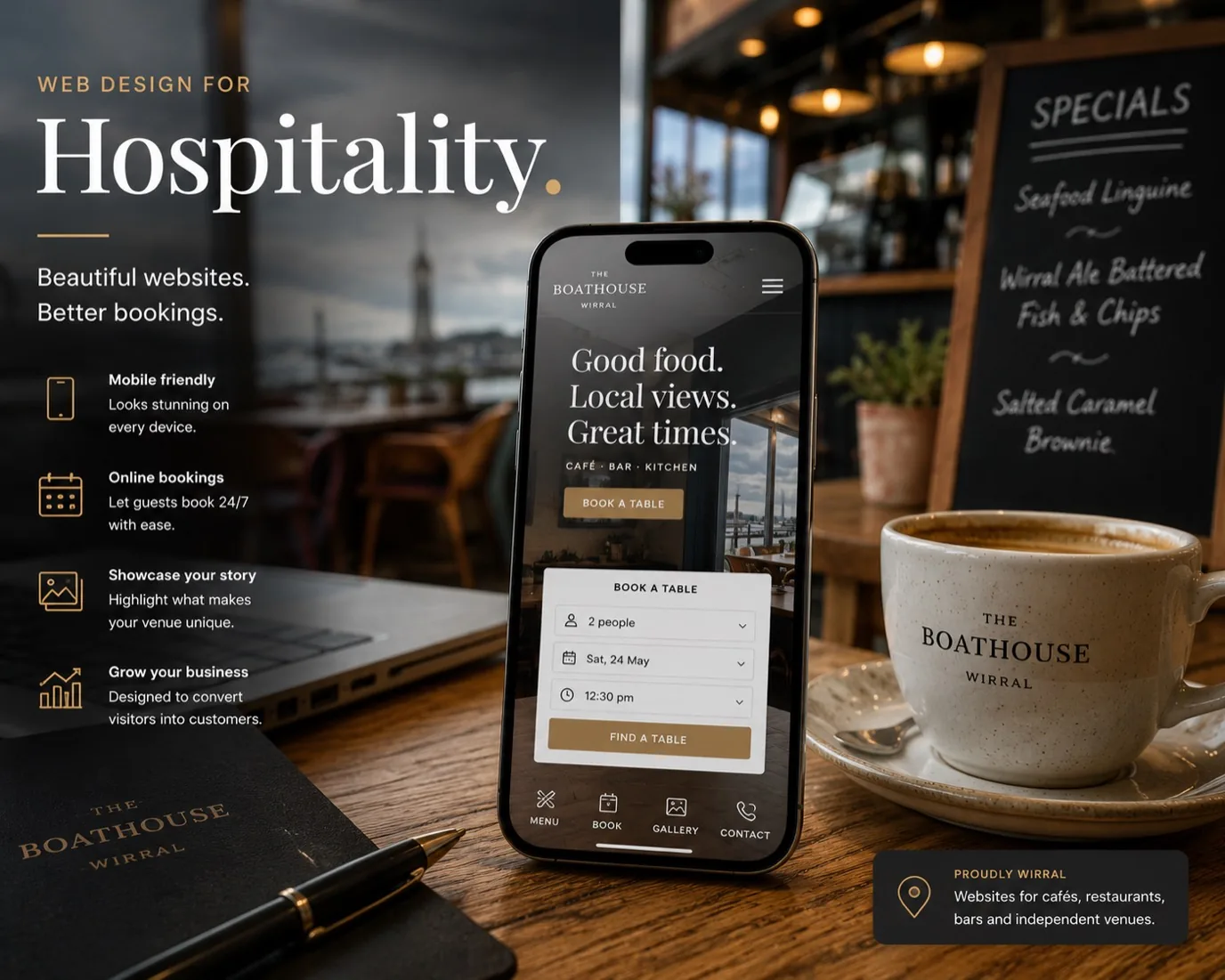
A Wirral cafe owner in Birkenhead gets an inquiry every day from someone asking if they're open, where they're located, what's on the menu. A restaurant in West Kirby gets the same questions repeatedly. Your website should answer those questions before anyone picks up the phone. For hospitality businesses, a good website does the selling while you're busy in the kitchen or on the floor.
Hospitality web design is different from generic business websites. Your customers aren't researchers or bargain hunters. They're hungry or thirsty, looking for somewhere good nearby, and ready to make a decision fast. They want to see your food, know where you are, see your opening hours, and ideally book a table or order online. A good hospitality website gets out of the way and does exactly those things.
What Hospitality Customers Actually Want
First, they want to see what you serve. Professional food photography on your website matters. People eat with their eyes first. A blurry photo taken on a phone camera signals amateur. A well-lit, appetising photo of your bestselling dish signals that you care about quality.
Second, they want to know if you're open right now. Outdated opening hours on your website are worse than no hours at all. People check at 6pm, see your site says you're open until 8pm, drive to Heswall for dinner, and find you closed on Mondays. Always keep your opening hours current, and ideally include today's status prominently.
Third, they want to find you. Your full address, postcode, and ideally a map. A link to your parking situation or public transport directions. If you're hard to find, people will go somewhere easier.
Fourth, they want the menu and ideally some sense of your prices. Not a PDF menu from 2019. An actual current menu showing what you offer and what it costs. Vegetarian and allergen information matters increasingly. Make it easy for customers to see if you cater to their dietary needs.
Fifth, if you take bookings or orders online, they want to do that on your site. Making someone call to book a table when they could book online is friction you don't need. The same applies to ordering food. If you deliver or do takeaway, show it on your site.
Photography and Visual Presentation
Hospitality is visual. Invest in decent food photography. This doesn't mean expensive commercial photography, though that helps. Decent smartphone photography with good natural light, careful plating, and attention to detail goes a long way. Show your best work, but show the work you actually deliver every day.
Show your space too. A photo of your dining room or kitchen builds confidence. People want to know what they're walking into. A tiny cafe that feels cosy because it's intimate is very different from a tiny cafe that feels cramped. Photos set that expectation.
Avoid cliche stock photos. A generic image of smiling people eating at a restaurant table is worse than no image. Use your own photos. Show your actual customers, your actual food, your actual space.
If you have a bakery, cheese counter, or open kitchen, use that as your hero. Show your process. People love to see bread being made or coffee being roasted. That authenticity is worth more than any marketing copy.
Menu Design and Presentation
Your menu is your salesman. Make it easy to read, even on a phone. Large enough text that a customer doesn't need glasses. Good contrast. Organised logically. Appetisers, mains, desserts, drinks. Or whatever makes sense for what you serve.
Include descriptions. "Fillet steak with peppercorn sauce and seasonal vegetables" tells a customer more than just "Steak." Descriptions build appetite.
Show your prices clearly. Hidden prices or confusing formatting signals that you're hiding something. Be transparent.
Highlight your specials or bestsellers. If your fish and chips is what keeps people coming back, feature it. If you change your menu seasonally, make that part of your brand story. "Fresh local produce, seasonal menu" is compelling.
Dietary information matters increasingly. Mark vegetarian and vegan options clearly. List common allergens. If you cater to dietary needs, say so. Customers with coeliac disease or severe allergies often research places before coming, and if they can't find information on your site, they assume you can't help them.
Takeaway and delivery. If you do it, make it clear on your site. Show how customers order and what the process looks like.
Location, Hours, and Practicalities
Your address and postcode should be prominent. A map embedded on your site is standard. Make sure your map marker is accurate. Many cafes and restaurants have incorrect maps, and customers end up confused.
Opening hours should be current and easy to find. Include closed days. Holidays and special closures. A note like "Bank Holiday Hours: Open 10am-4pm" prevents frustration. If you're closed Mondays, say so. Assume your customer is checking at inconvenient times.
Parking information helps. Even if you don't have your own car park, saying "Metered parking on Chester Street" or "Close to West Kirby station" is useful. For places in Liverpool or Birkenhead city centres, customers want to know if parking is easy or difficult.
For restaurants that take bookings, have a booking system on your site. This might be a simple form or a booking app. Either way, customers should be able to book without phoning. A phone number should still be visible for customers who prefer to call.
Building Trust for Local Hospitality
Local matters in hospitality. You're competing with chains and online delivery. Your advantage is being local, being personal, being part of the Wirral community. Use that.
Show your story. Where did you open? Who's behind the business? A personal note from the owner means something. "Started by two friends from Bebington who love food" or "Family run for over ten years" builds connection.
Reviews and testimonials. If you have good reviews on Google or social media, feature them on your site. People checking your website for the first time want social proof that you're good.
Social media links. If you're active on Instagram, link to it from your site. Show your recent posts. A hospitality business that's active on social is more trustworthy than one that isn't.
Community involvement. If you sponsor a local team or event, mention it. If you use local suppliers, say so. That connection to Wirral matters to locals deciding where to eat.
Performance and Mobile
Your hospitality website will be viewed on phones in pockets and cars and bedrooms. Slow load times don't work. Optimize your images so they load fast. Keep the design simple and clean. Don't add unnecessary features.
Mobile-first design is essential. A customer scrolling through your menu on their phone shouldn't have to zoom in and scroll sideways. Everything should be clear and easy to navigate with one hand.
A sticky header showing your opening hours and booking button is useful. People scroll down to look at your menu and images, but they want those practicalities always visible.
Frequently Asked Questions
Should I use a booking system on my site or a third party app?
Both work. A booking system on your site keeps customers on your site, but requires more maintenance. A third party app like Resy or a local restaurant platform takes some work off you. Choose based on your capacity and customer preferences. Many restaurants use both.
How often should I update my menu on my website?
As often as it changes. If you change specials daily, update daily. If you have a static menu that changes seasonally, update it when the season changes. Out-of-date menus lose trust.
Should I sell food directly from my website or use a delivery platform?
Selling directly from your site gives you better margins and customer relationships. But delivery platforms bring customers who wouldn't otherwise find you. Many successful hospitality businesses do both. Start with what works for your current customers.
Do I need high-end food photography?
Professional photography helps, but good smartphone photography with natural light works too. What matters most is that your food looks appetising and your space looks welcoming. Authentic beats overly polished.
How do I compete with chain restaurants online?
You're local, you're personal, you're part of your community. Feature that. Show your story, your team, your suppliers, your involvement in Wirral. Let us build a website that showcases what makes your hospitality business unique.