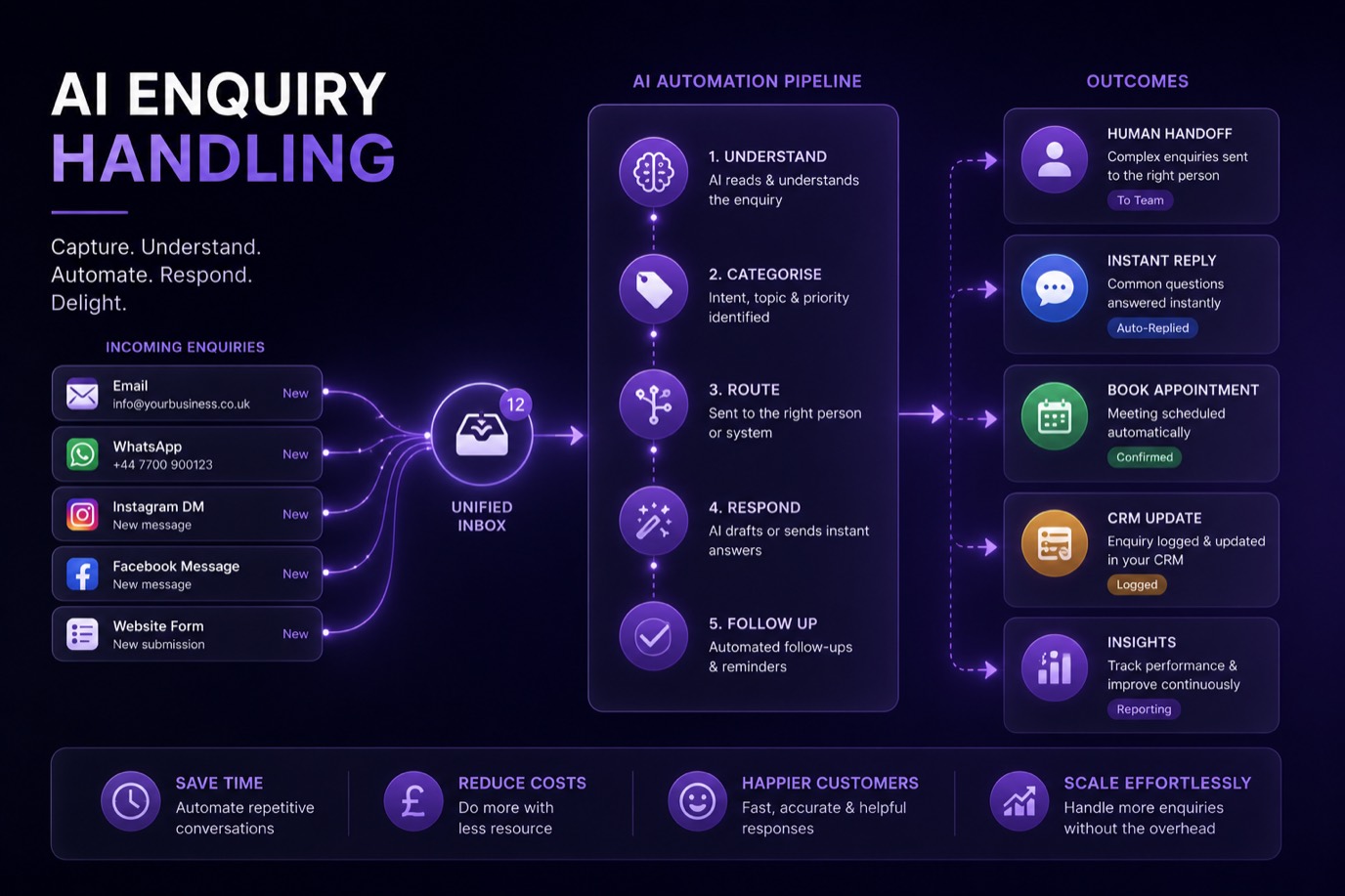
Missing leads because you were too busy to respond to them immediately is one of the most frustrating problems a small business faces. Your marketing brings someone to your website, they fill in a form or send an email at 8pm on a Tuesday, and by the time you read it the next morning, they've called three competitors instead. Automated enquiry handling solves that problem at its root.
The system works like this: the moment someone submits an enquiry from any channel (your website form, email, phone message), an intelligent automation reads it, understands what they're asking for, and decides what to do next. Some prospects get an immediate response. Some get added to a nurture sequence. Some go straight to your sales team. No human has to triage anything manually.
Why Immediate Response Matters
Quick responses matter. When someone fills out a form or sends you a message, they're in a problem-solving mindset right then. They're comparing your business to competitors. By the time you get to them six hours later, they've already moved on.
An automated system doesn't have to be perfect. It just has to be fast. A simple acknowledgement that says "thanks for getting in touch, we'll be in touch within X hours" sent within seconds is enough to make that person feel like you're responsive and professional. It keeps you front of mind while they're thinking about their problem.
Lead Scoring and Qualification
Not all enquiries are equal. A customer asking about a service you don't offer isn't the same as someone ready to buy today. Automated systems learn to score leads based on patterns in your past business.
Example: A digital marketing agency in Liverpool gets enquiries from website owners, ecommerce businesses, and occasionally random requests. An intelligent automation system reads each enquiry and scores it based on the business type, budget signals, urgency language, and other factors. High-scoring leads go to the business development team immediately. Medium leads go into a nurture sequence. Low-scoring leads get a templated response explaining what you do and when they might be ready.
This isn't rigid. You set the rules. If certain keywords (like "urgent" or "this week") appear, that bumps the priority. If someone mentions they're already working with a competitor, that changes how you respond.
Routing to the Right Person
Once an enquiry is understood, it needs to go to the right person. A plumbing emergency goes to the on-call plumber, not the admin assistant. A website design enquiry from a salon goes to the designer who understands that market. A question about your processes might need to go to the owner.
Automated routing handles this instantly. Instead of an email sitting in a shared inbox until someone notices it, it's in the right person's queue within seconds. That person can see at a glance why it was routed to them (a summary of the enquiry) and what priority level it is.
Keeping Prospects Warm
Not every enquiry is ready to book right now. But that doesn't mean you should ignore them. An automated nurture sequence sends relevant content at intervals: a case study relevant to their business, a pricing guide, a testimonial from someone in their industry, an invitation to a discovery call.
This works because it's automated and consistent. A prospect might not respond to your first message, but after three or four helpful touches over a few weeks, they remember you when they're actually ready to move forward. And you never had to manually follow up because the system did it for you.
Frequently Asked Questions
Will automated responses seem impersonal to customers?
No, if they're done well. Customers expect and appreciate fast responses. An automated response that's personalised to their specific enquiry (referencing what they asked about, using their name) feels just as professional as a manual response. Most people are happy to get an instant acknowledgement followed by a personal reply from a human within hours.
What if the automation routes an enquiry incorrectly?
Good automation systems are built with fallbacks. If an enquiry doesn't clearly fit any category, or if the system is uncertain, it flags it for a human to review rather than routing it blindly. Over time, as the system learns your business patterns, misroutes become rare.
Can I still personalise responses if they're automated?
Completely. Automated doesn't mean generic. A good system reads the enquiry, understands what the person is asking for, and personalises the response based on that. It's not sending the exact same message to everyone. It's generating a response that's relevant to that specific enquiry.
What channels can automated enquiry handling work with?
Most modern systems integrate with email, website forms, phone (via transcription), Facebook or Instagram messages, and chat. Every time someone gets in touch, the automation can read it regardless of the channel. So you're not managing five different inboxes anymore.
How do I avoid automations sending too many follow-ups?
You set the rules. You decide how often to follow up, on what day, and to which types of leads. High-value prospects might get follow-ups every week. Low-priority leads might get one follow-up and then nothing. You're always in control of the frequency and messaging.
Getting Started
The best place to start is with your current lead handling process. Track how many enquiries you get each week, how long it takes to respond to them, and how many leads go unanswered because you're too busy. Those numbers tell you exactly how much value automated enquiry handling would unlock for your business.
Talk to us about setting up automated enquiry handling for your business. We can help you understand your current lead loss and design a system that keeps more prospects in your funnel.
The Compounding Effect
Every lead that gets a fast, relevant response is more likely to convert. Every prospect that gets consistent nurture messaging is more likely to remember you when they're ready. Every enquiry that's routed to the right person gets handled faster. These small improvements compound over months and years into significantly better business outcomes.
Automated enquiry handling isn't about replacing your team or being impersonal. It's about making sure no lead falls through the cracks because you were too busy to respond. In a small business, that can be the difference between good years and great ones.