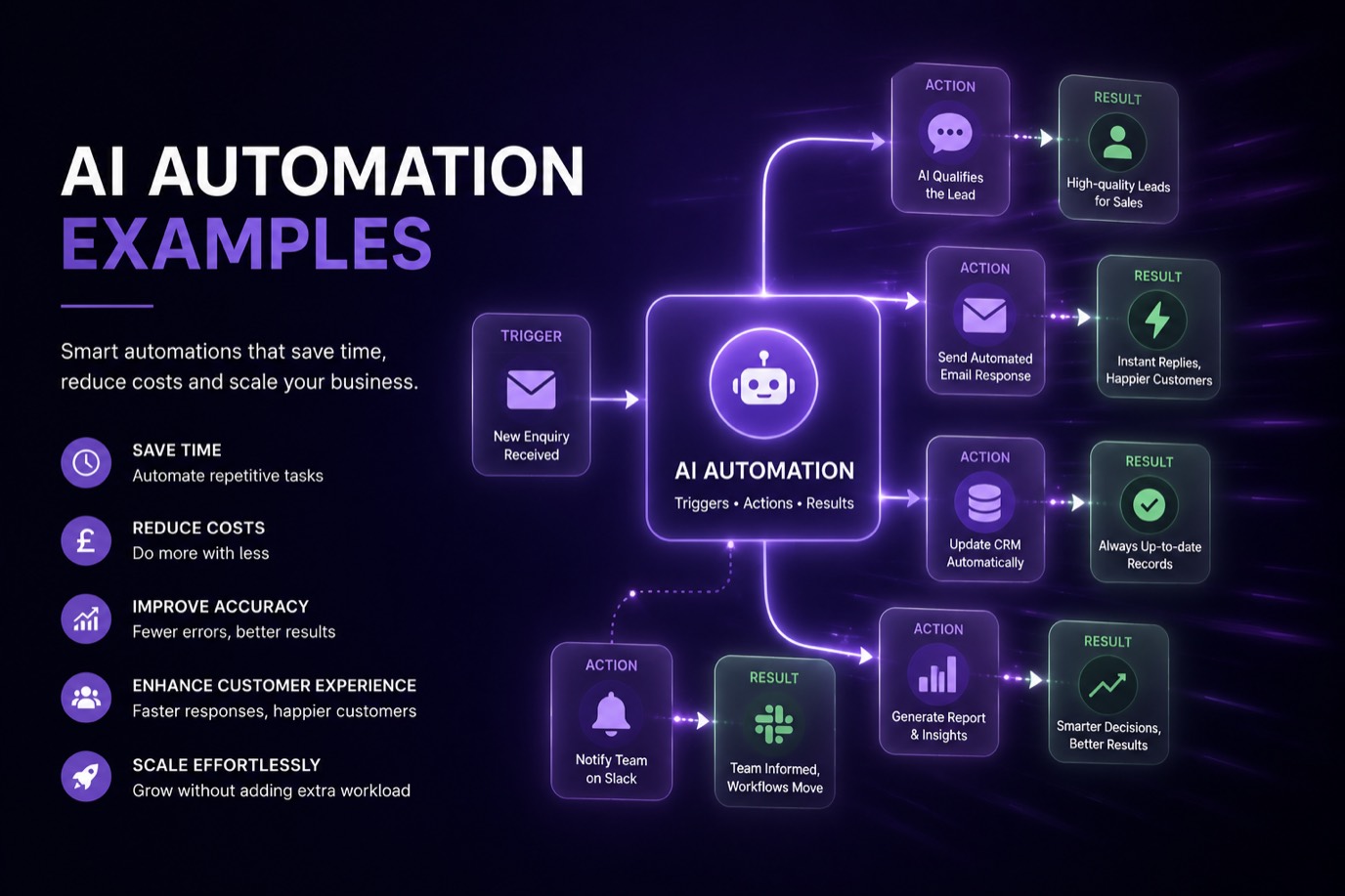
Small businesses often hear about AI automation and think it's something for tech companies or large enterprises. In reality, some of the quickest wins come from automating the repetitive tasks that eat up your team's day right now. Whether you're in fitness, trades, services or retail across Merseyside, there's likely an automation that could free up hours every week.
What AI Automation Actually Means
When we talk about AI automation for small businesses, we're not discussing replacing your team. We're talking about intelligent systems that handle routine work: filtering enquiries, sorting leads by quality, sending follow-ups, scheduling appointments, answering common questions. These systems learn patterns from your business and take actions based on rules you set.
The real value isn't in the technology itself. It's in what your team does with the time you save them. One admin person freed from manual email sorting can focus on actual client relationships. One manager no longer chasing down appointment confirmations can work on growth.
Lead Qualification and Scoring
If you get more than a handful of enquiries a day, you're spending time sorting the serious prospects from the time-wasters. An automated system reads each new enquiry, checks it against your ideal customer profile, and assigns a score. High-quality leads go to your sales team immediately. Low-scoring leads get added to a nurture sequence instead.
Example: A plumbing business in Liverpool receives 20+ leads a week from multiple channels. An automation system reads each one, notes the postcode, job type, and communication urgency. Emergency jobs go straight to the team. Non-urgent jobs go into a follow-up sequence that keeps the business top-of-mind when the customer is ready.
Email Management and Responses
Most small business owners and managers spend hours every day reading and responding to email. An AI system can read incoming emails, categorise them by type, assign them to the right person, and even draft responses for common questions that your team just needs to approve.
This isn't about sending robotic replies. It's about a system that understands your typical email patterns and uses them to save everyone time. A veterinary practice might use this to auto-sort appointment requests, reminders and emergency calls into different queues. A design agency might use it to acknowledge new enquiries immediately and collect project details without a human having to start the conversation.
Appointment Confirmations and Reminders
No-shows and missed appointments hurt revenue and waste everyone's time. A system that sends automated reminders 24 hours before an appointment (and again 2 hours before) can significantly reduce no-shows. Better systems can also handle rescheduling: if someone can't make their slot, they can ask the system to find an alternative.
A salon or personal training studio on the Wirral could meaningfully reduce missed appointments through automated reminders. That's direct revenue recovery.
Summarising Customer Requests into Tasks
When customers submit forms or leave voicemails, you want the relevant information captured immediately. A system can read these submissions, extract the key details (customer name, issue type, any budget or timeline mentioned, urgency signals), and automatically generate a prioritised task for your team. A builder might receive an enquiry form about a loft conversion, and the system creates a task tagged with the property type, location, stated budget if given, and timeline. A consultant might get a voicemail about an urgent problem, and by the time they check their email, there's already a task with a transcribed summary, priority flag, and callback number. Your team no longer spends the first ten minutes of each day just getting up to speed on what came in overnight.
Frequently Asked Questions
Do I need technical skills to set up AI automation?
No. Most modern automation platforms are designed for business owners and managers who've never written code. You describe what you want in plain language, connect your business tools (email, forms, scheduling software), and the system learns from your existing patterns. A small business can start with simple automations and expand over time.
Will AI automation replace my staff?
Automation replaces tasks, not people. It removes the boring, repetitive work that most people don't enjoy anyway. Your team can then focus on client relationships, problem-solving and strategic work that actually matters. Businesses that automate well usually find their team is happier and more productive, not smaller.
How long does it take to see results?
Some automations show results within days: you'll notice fewer admin emails or faster enquiry turnaround immediately. Others take a few weeks to tune properly. Most small businesses see tangible time savings within the first month, and those savings compound as you add more automations.
What if the automation makes a mistake?
Good automation systems are designed to handle routine decisions, not critical ones. You set rules and thresholds that match your judgment. If a lead doesn't clearly fit your criteria, the system flags it for a human to review rather than making an assumption. Mistakes should become rarer as the system learns.
How much does this cost?
Costs vary widely depending on what you're automating and which tools you use. Some small business automation can be set up with tools you're already paying for (your email platform, scheduling software, forms). More complex automations might require dedicated software, but the cost is usually modest compared to the time you recover.
How to Start
You don't need to automate everything at once. Pick one painful, repetitive task your team does every week. Track how many hours it takes. Then explore what automation could do for your business and see if the numbers make sense.
The businesses that get the most from automation aren't the fastest to adopt it. They're the ones who pick one clear problem, solve it well, and then move to the next bottleneck. That measured approach means you understand the value as you go.
The Real Benefit
When you step back, the benefit of AI automation isn't really about the technology. It's about doing more business without doing more work. A two person team can handle the client load of a four person team if the right tasks are automated. That's what changes the economics of a small business.
If you run a service business, take a week and write down every repetitive task someone does. Phone calls, emails, scheduling, forms, follow-ups. Look at that list and ask yourself: is there one thing we spend five hours a week on that could be automated? Start there. The gain compounds faster than you'd expect.