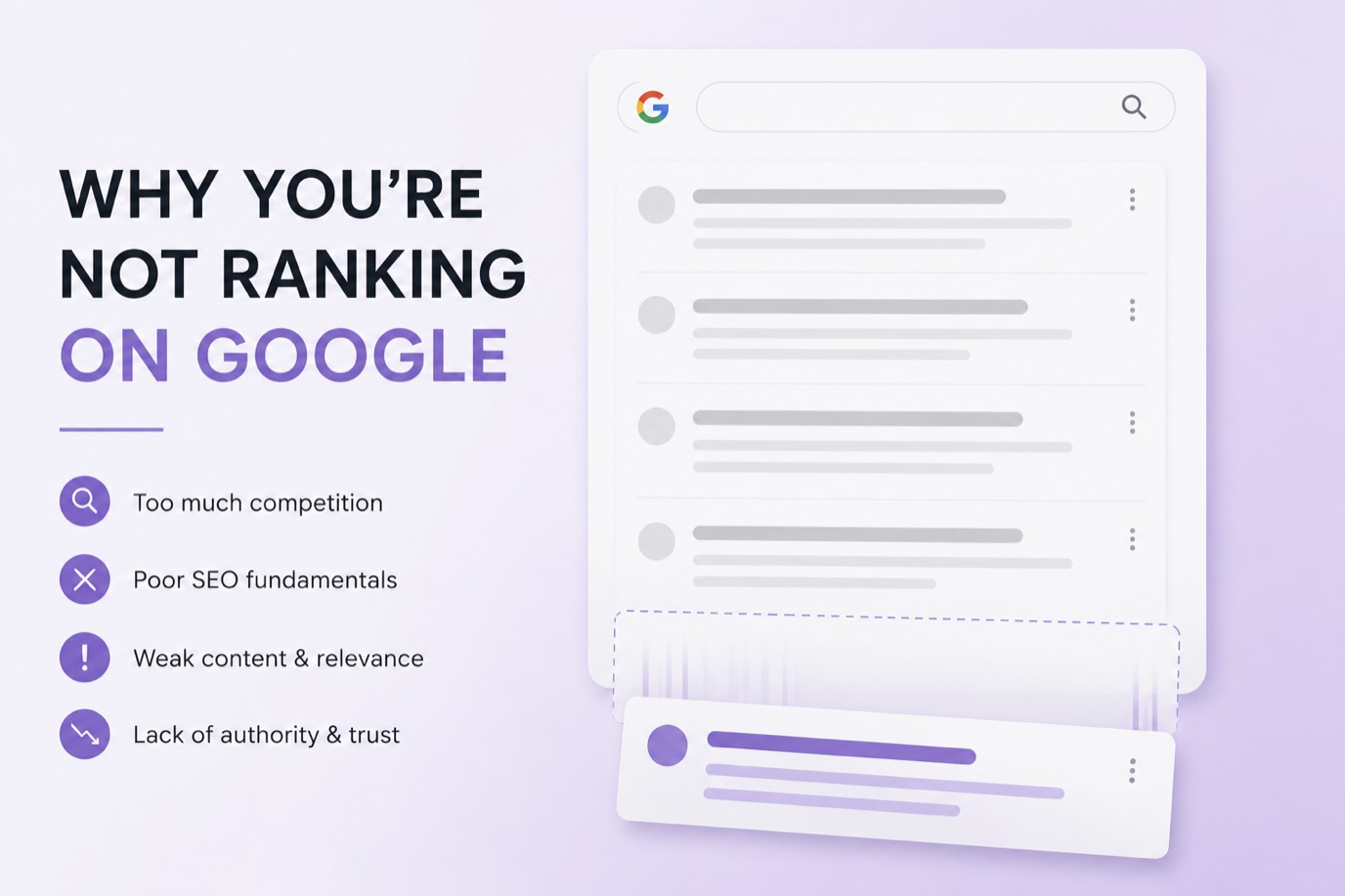
You built a website. You've been waiting months. But when you search for your business name plus your service, your site barely appears. When you search for the problem your customers are trying to solve, someone else shows up instead. It's frustrating because your website looks good, and your service is genuinely better than some of the sites ranking above you. So what's actually going on?
The truth is simpler than you think. Your site probably isn't ranking because Google doesn't know your site exists yet, or doesn't understand what it does, or both. Ranking isn't about being the best. It's about Google understanding who you serve, what problem you solve, and whether you're genuinely relevant to what someone is searching for right now.
The Real Reason Most Small Business Sites Don't Rank
If your site has been live for a few weeks or even a few months, the simplest reason it's not ranking is time. Google takes time to crawl sites, index them, and understand what they're about. A brand new site with no backlinks, no established authority, and no history typically doesn't rank for competitive searches in the first 3 to 6 months. That's normal.
But if your site has been live longer than that and still isn't ranking for anything, the issue usually isn't time. It's usually one of three things: Google can't find your site, Google doesn't understand your site, or your site isn't relevant to what people are actually searching for.
Is Google Even Finding Your Site?
Before anything can rank, Google has to find it. If your site is blocked from search engines, uses navigation that's hard for bots to follow, or is hosted in a way that makes crawling difficult, Google might not see it at all.
Check your robots.txt file and sitemap. If your sitemap is missing or outdated, or if your robots.txt is blocking search engines, Google won't index your pages. It sounds obvious, but many small business sites have technical barriers that were never intentionally created. They just happen after a website redesign or migration. A quick audit of Google Search Console will tell you if Google is actually crawling your site and indexing your pages.
Does Google Understand What Your Site Does?
Once Google finds your site, it needs to understand it. For many small business websites, this is where things fall apart. The site might say "We help businesses grow" or "We're a digital agency" but doesn't clearly answer who the business serves or what specific problems it solves.
If you run a gym on the Wirral, Google needs to know you're a gym in that specific location. Not just a gym somewhere in the UK. If you're an electrician, Google needs to understand you're an electrician, where you operate, and what electrical services you offer. If you sell a specific product or service, Google needs that clarity too.
This is why many small business sites don't rank. They're too vague. They describe themselves in ways that make sense to them but don't clearly signal to Google what they actually do. Add location details to your main pages. Use specific language. If you serve a particular type of customer or solve a specific problem, say that clearly on your site.
Are People Actually Searching for What You Offer?
Here's where many small business owners get frustrated. You might have a brilliant website that Google understands perfectly. But if no one is searching for what you're offering using the words you've chosen, you won't rank.
A lot of small business sites target keywords that either don't exist, or exist at such a tiny scale that ranking for them brings zero traffic. You might be the best pet groomer in Wirral, but if only five people a month search for "pet grooming near Wirral", ranking first place only gets you so much.
Real search traffic comes from being relevant to the actual questions and searches happening in your area and industry. Use Google Search Console to see what real people are searching for when they find your site. Then optimise your content around those genuine searches.
Building Something Google Wants to Rank
Once you understand where the problem is, fixing it becomes straightforward. Google wants to rank sites that are relevant, clear, and trustworthy. Your site needs to tick all three boxes.
Relevance means your site actually answers what people are searching for. Clarity means Google understands who you serve and what you do. Trustworthiness comes from having real, helpful content and signals of legitimacy. If your site is vague, full of marketing fluff instead of useful information, or doesn't clearly match what people are searching for, ranking will be hard.
The fastest way forward for most small businesses isn't secret. It's making sure your site is technically sound, clearly describes what you do and who you serve, and provides genuinely useful information to the people finding it. Then give it time.
Frequently Asked Questions
How long does it actually take to rank on Google? For a new small business site with no backlinks, expect 3 to 6 months before you start seeing movement on competitive searches. Simple branded searches or very low-competition keywords might rank faster. Existing sites that are improved or rebuilt can improve faster if the fundamentals are fixed quickly.
Does my website need backlinks to rank? Not necessarily to start, but yes to compete. A brand new site with excellent on-page SEO and clear relevance can rank for low-competition searches without backlinks. To rank for more competitive searches, you'll need other sites linking to you, which signals trustworthiness to Google.
Should I hire someone to do SEO or try to do it myself? If your time is better spent running your business, hire someone. If you enjoy learning how websites work and have time to experiment, you can learn the basics yourself. Many small business owners do a hybrid approach. Start the fundamentals yourself, then bring in help for the parts that need expertise or time.
Is it worth paying for ads while I wait to rank organically? It depends on your business. Ads can bring traffic immediately while your organic ranking builds. But ads aren't permanent. As soon as you stop paying, the traffic stops. Investing in organic ranking means traffic that lasts.
What's the difference between SEO and GEO? SEO is about ranking across the broader internet. GEO is about ensuring your business is accurately represented on Google Maps, search results, and AI tools so local customers can find you easily. For local small businesses, GEO is usually more important than competitive national SEO.
Ready to find out why your specific site isn't ranking? Get in touch with us and we can audit your site and tell you exactly what's holding you back.